Every agency you'll find was built for dealerships and parts brands. Osiris is the first digital marketing infrastructure built exclusively for sport bike specialty shops — the people doing the ECU tunes, the suspension builds, the track prep. One territory per market. When your slot fills, it fills.
The complete breakdown of what that exclusivity position includes — territory lock, full-stack infrastructure, quarterly war room sessions, and the full niche architecture for this vertical — is at The Anchor Position.
The sport bike performance vertical has exactly zero dedicated agencies. Run "sport bike shop digital marketing" right now — you get dealership chains, parts e-commerce platforms, and motorcycle brand content. Not a single result built for specialty service shops doing tunes, suspension work, and track prep.
Every platform that has touched this vertical was built for Honda dealers selling units. Your shop builds machines. Those are not the same business. They do not have the same marketing requirements, the same buyer, or the same search intent.
Meanwhile, your highest-value prospects are running exact queries — "CBR1000RR ECU tune [city]", "R6 suspension setup [city]", "ZX-10R track prep near me" — and landing on nothing. A blank SERP. The question is not whether the search is happening. The question is whether your shop is the answer when it does.
If your website was built from any template that could have served any shop from any vertical, it is not doing the work it needs to do.
Sport bike culture went mainstream and the market fractured. Specialty performance shops multiplied — shops with real craft, real customers, real reputations. But the digital infrastructure to put those shops in front of buyers at the moment of search has never been built. The buyer running a query before they call anyone will find whoever showed up online — not necessarily whoever does the best work.
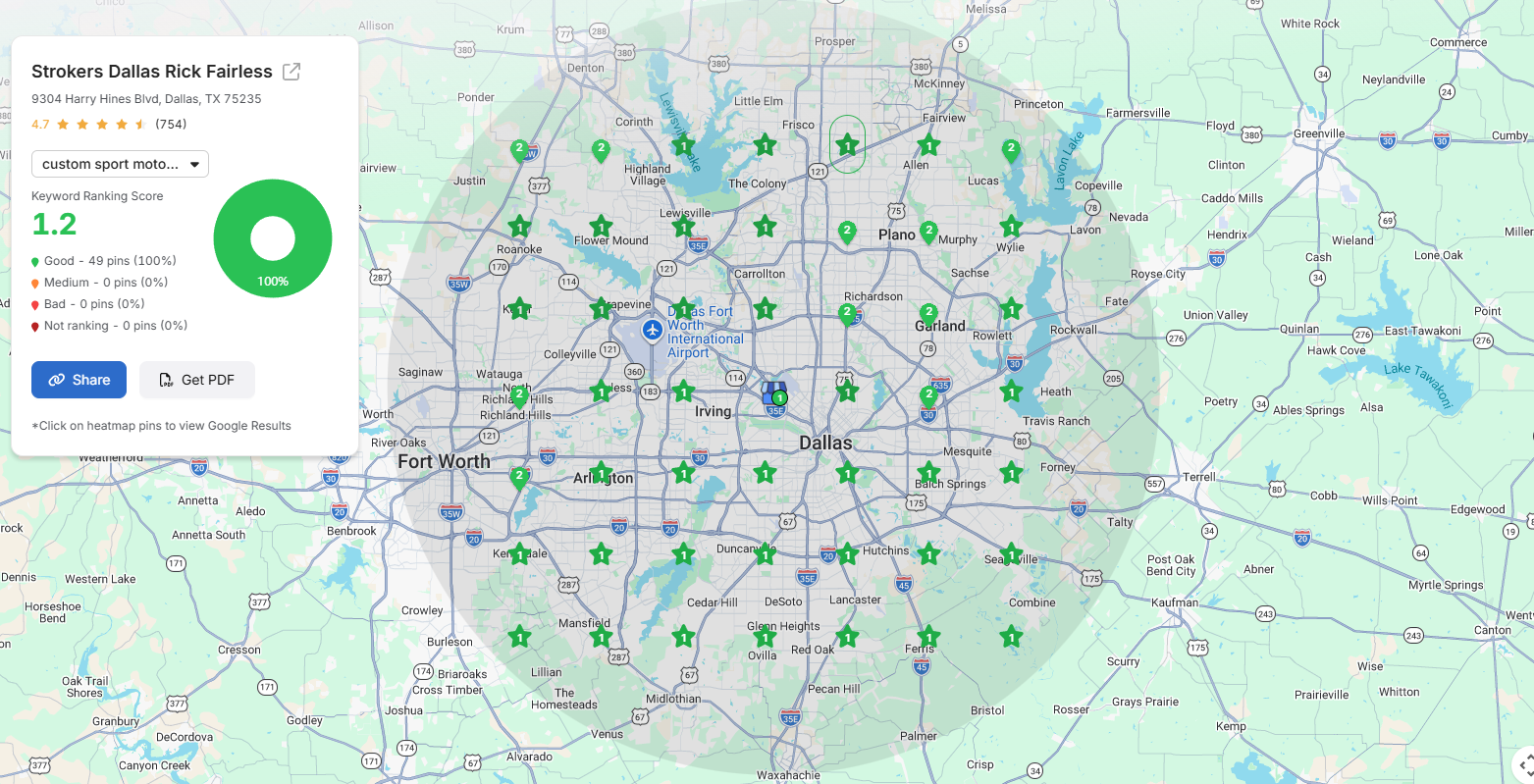
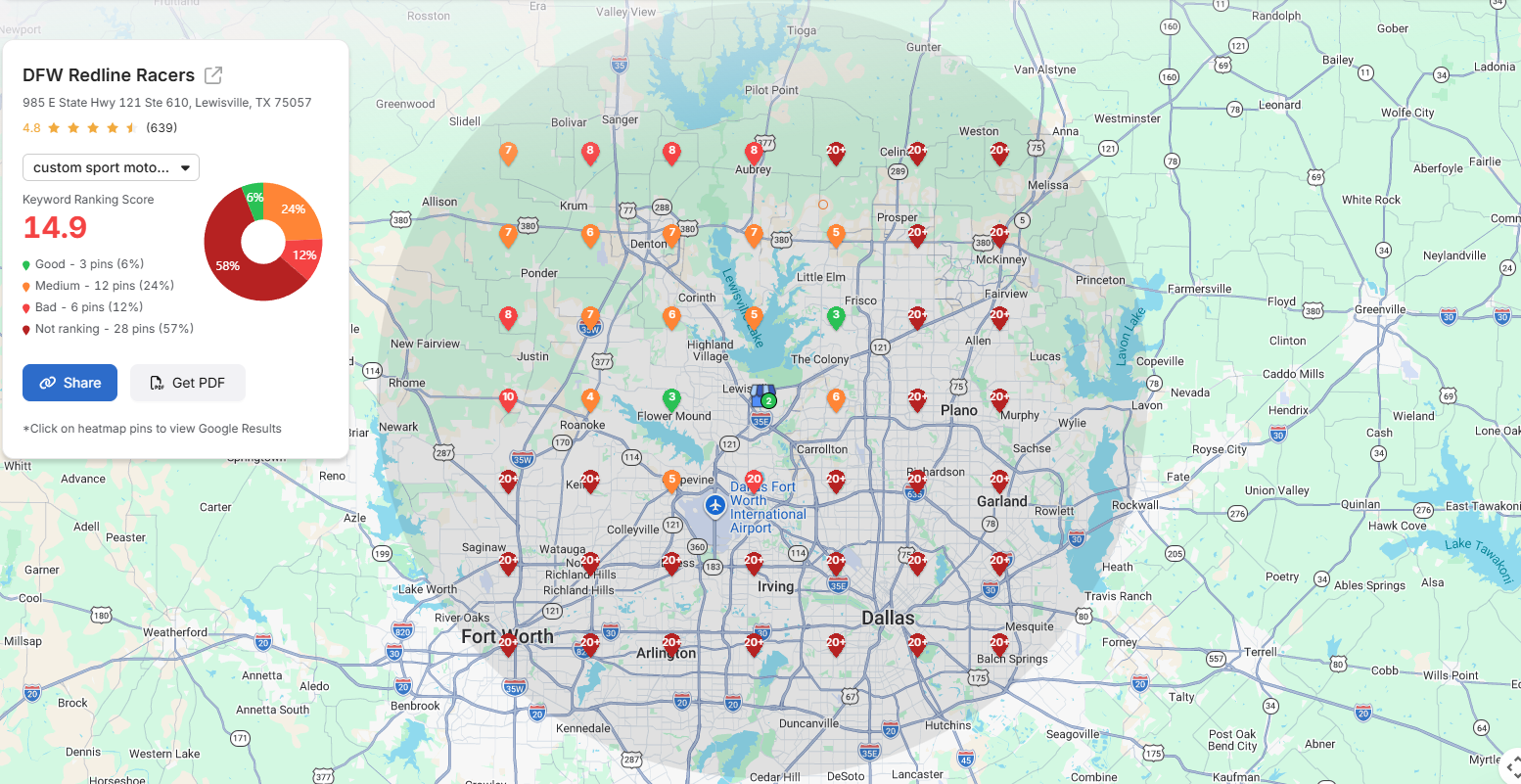
Here's what that looks like in one of the largest markets in the country. Search "custom sport motorcycle shop Dallas." One shop dominates the entire metro — not because their SEO is engineered, but because they are the only shop in a major American city that built any digital presence at all. The shop ranked behind them has 639 reviews at 4.8 stars — and is invisible across the majority of their own city.
Strokers Dallas is the cruiser and custom motorcycle anchor in DFW — a lifestyle brand built over decades with a bar, a YouTube channel, and more community presence than anyone in the metro. They rank here because they service all motorcycle types and have built more content than every other shop in the city combined. But they are not a sport bike performance shop. DFW Redline Racers — 639 reviews, 4.8 stars — is. And they do not appear in local search across 57% of their own metro. The gap between those two maps is not who does better sport bike work. It's that no dedicated sport bike shop in DFW has ever built the infrastructure to hold this position — and Strokers holds it by proximity. In your market, this slot is likely still open. The first shop that builds real infrastructure takes it.
The rider booking a $3,500 suspension build or an ECU flash and data logging session is not using your website the way someone looks for an oil change. They're doing research. They're comparing shops. They're reading service pages, looking for evidence of specific platform work, checking whether you actually know the machine they're running.
A generic website built from a motorcycle template — or a GBP listing with no site behind it — fails that evaluation before the conversation begins. Every Osiris sport bike site is built with a full page architecture mapped to your vertical: ECU tuning and power commander setup, suspension valving and full rebuild, track prep and race day service packages, fairings and crash repair, platform-specific pages for CBR, R-series, ZX, GSX-R, Panigale, S1000RR, and RSV4. Built in the Osiris design system, hosted on Osiris infrastructure, included in your monthly retainer.
You do not own it. You operate it. That is the model. No existing site can be optimized under Osiris — the infrastructure is built to spec from the ground up or it does not function as designed.
Service architecture mapped to the vertical. GBP-optimized from day one. CRM-connected intake. The floor every territory anchor starts on.
Platform-specific service pages for CBR, R-series, ZX, GSX-R, Panigale, and S1000RR. Extended service depth. Authority structure built for competitive markets.
Full model and service coverage across all platforms and disciplines. Content moat that competitors cannot replicate. Maximum territory hold.
Sport bike buyers search by platform, by discipline, and by specific service — not by generic terms. The shops that rank for those queries own the inquiry. The shops that don't are invisible to their highest-value prospects.
Broad terms — "motorcycle shop near me" — route to dealerships and service chains. Platform-specific terms route to your shop, if you have the architecture to hold them.
Osiris deploys OTTO on every anchor site for continuous technical health monitoring and on-page optimization across all indexed pages. GBP is actively managed and included in the Social Planner cadence. Competitive keyword gaps are tracked monthly — if a competitor moves on a term your shop should own, it gets addressed before you see the traffic drop.
When your shop joins the Osiris network, you get a dedicated profile on osirisautoguild.com — the Osiris-owned specialty automotive directory. One vetted shop per specialty per city. That is the consumer-facing function. The infrastructure function is what most shops never think about until they see it working.
The DFW Guild page is live and active. My Detail Guys — a founding network node, 17 years in business, 510+ Google reviews — has a dedicated external profile on osirisautoguild.com documenting every infrastructure change Osiris made and every result those changes produced. That profile is written by Osiris, from an external perspective, and links back to the shop. That is what Guild membership looks like at full execution.
The Guild is the consumer-facing face of the network. The network node program is how adjacent service shops plug into it, and how we manage every client's infrastructure is what keeps the whole system performing.
The highest-value rider in this vertical — the one booking $4,000–$8,000 in services annually — does not call. They submit a form, or they DM, or they send an inquiry at 11pm on a Tuesday after watching a build video. If your shop does not have an automated response sequence, that lead is cold before you open the next morning.
Every Osiris anchor client runs a CRM automation layer built for this vertical. Inquiry lands → confirmation fires in under 90 seconds → nurture sequence starts → appointment reminder goes 48 and 24 hours out → no-show recovery triggers if they miss. Every lead lives in a single pipeline. Nothing falls through because someone was on a lift.
The CRM layer is part of the retainer. It is not an add-on. It is not optional. It runs whether your shop is open or not.
Every company that has tried to build something like this has made the same mistake: spread to as many cities as they can reach, sign one or two shops per city, and discover that a half-built network produces nothing for anybody. Referrals require volume. Volume requires a complete network behind it. A directory spread thin across twenty cities is just a list of shops who paid for a promise.
Osiris operates on a different rule: one complete region before touching the next one. The Texas Triangle is the first region. Dallas–Fort Worth, Houston, San Antonio, Austin — treated as one economic unit, because that is already how the market behaves. Customers, shops, and specialty automotive commerce move freely between those four cities in ways that don't respect city lines. The Osiris network formalizes what was already happening.
And the execution reality: every DFW prospect can be called in a week. While those calls are working through the pipeline, Houston outreach begins. While Houston is in motion, San Antonio and Austin follow. The cities are worked in parallel because the outreach cadence allows it — and because artificial sequencing within a region that already has economic ties serves no one.
The commitment: every anchor vertical and universal node category across all four Texas Triangle cities — 100% filled — before Osiris opens in another state. Not majority-filled. Not mostly done. Complete. After the Triangle is proved across multiple cities with different competitive conditions: other states.
This is the same territory and anchor model laid out in how Osiris works and the full vision behind the build — and the position it describes is the one explained in who the anchor is for.
The proof is already live. Two founding network nodes — My Detail Guys and My Upholstery Guys, Dallas–Fort Worth, inside the Osiris network since 2025 — produced 48% gross revenue growth, doubled full-time headcount, and 73 new Google reviews in 8 months. That happened before the first anchor vertical ever signed in DFW. Infrastructure alone did that. The anchor network and referral layer activate on top of that foundation.
That infrastructure was built by an operator who came up in the specialty trades, not in marketing — the Osiris story.
Every agency that has ever approached you was built for brands, dealerships, or general automotive. They adapted their templates, pointed generic tools at your vertical, and called it specialty marketing. Osiris was built exclusively for specialty shops — not adapted for them. The page architecture, the SEO strategy, the CRM automation, and the territorial exclusivity model are all engineered around the specific business of running a high-ticket sport bike performance shop. There is no other infrastructure company in the country doing what we do for this vertical.
By building the infrastructure that captures your highest-value riders at the exact moment they are actively searching, and making sure they do not go unanswered. The two highest-leverage moves in this vertical are: page architecture that ranks for specific platform and service queries — not generic motorcycle terms — and a CRM automation sequence that responds to every inquiry within 90 seconds, including at midnight on Sunday.
The fastest path to higher margin is a higher-ticket service mix — attracting riders planning full suspension overhauls, ECU flashes with data logging, track prep packages, and multi-day race service rather than walk-in tire mounts. The page architecture Osiris builds is designed to attract that buyer specifically, because it speaks the language of the work that actually moves the number.
The most immediate answer is search presence for platform-specific service queries — the riders planning a real build are running those searches right now, and most shops in this vertical are invisible to them. Beyond search: the Osiris referral network means the other specialty shops in your city — lifted truck shops, diesel shops, powersports shops — refer to you by name because you hold the anchor position. That cross-vertical referral volume compounds over time and only exists because of territorial exclusivity.
Long-term growth in this vertical requires three things working in parallel: owning your search territory before the competition understands why it matters, building a CRM infrastructure that captures every inquiry and every returning client, and having a digital presence credible enough to pass the six-second research test your buyers run before they call. One without the others loses revenue at a different point in the funnel. All three have to be in place.
It starts with page architecture built around specific platforms and disciplines — not generic motorcycle service terms. Then technical health: schema markup, page speed, mobile performance, GBP optimization, citation consistency across 30+ directories. Then ongoing competitive monitoring to identify gaps and respond before traffic moves. Osiris handles all three layers continuously. OTTO runs technical monitoring across every indexed page. Monthly competitive audits track keyword movements and flag gaps before they cost you the search position.
Osiris signs one sport bike anchor client per metro territory. One. That shop holds the search infrastructure, the referral routing, and the community positioning for the vertical in that market for as long as they hold the retainer. No other Osiris client in that city competes with them for sport bike territory.
This is not a pitch. It is a structural fact enforced in every MSA and written into the agreement. The exclusivity is the product. Without it, the model does not hold.
CRM-only clients are not subject to territorial anchor restrictions. If the SEO slot in your market is already filled, you can still be onboarded to the CRM and automation infrastructure — you simply do not hold the search territory.
If your slot is open, you'll hear from Daniel directly. If it's filled, you'll be informed and offered CRM access.