Off-Road Park Marketing
and Race Track
Revenue Infrastructure
Website, SEO, and CRM engineered for parks and tracks — the infrastructure that puts you in front of the leisure consumer before they end up somewhere else.
One Slot.
One State.
When It Fills,
It Fills.
One off-road park. One race track. One karting center. One motocross track. One drag strip. Per state. The statewide search footprint Osiris builds for each venue type only works at full strength when it belongs to one operator. Splitting it across competing properties in the same state fragments the advantage. The off-road park in Tennessee that signs first owns that state. The one that waits finds out the slot is gone.
Motorsport Venue Marketing: One Infrastructure Gap Across Every Type
The digital gap across parks and tracks is not uniform, but the cause is the same everywhere: these businesses were built by people who love the sport, grew through the community that loves it with them, and were never designed around capturing the consumer who hasn't found it yet.
Multi-use OHV facilities serving trucks, Jeeps, dirt bikes, and SxS on a single property. Trail systems across difficulty ratings, camping, seasonal events. Wind Rock is the archetype. The broadest visitor base and widest search footprint of any venue type.
Dedicated facilities for UTV, ATV, and SxS. Often include rental fleets, guided experiences, and beginner-accessible terrain. Growing fast as manufacturers actively expand the consumer market. The highest first-timer percentage of any venue type on this list.
Facilities built for competitive off-road racing: rally stages, short-course circuits, desert race events, endurance. Spectator infrastructure. Race day hosting. Needs to show up for both competitor entries and spectator attendance searches.
Outdoor MX tracks for practice sessions, race days, amateur competition, coaching, and rider development. Some serve a single club. Others host regional events drawing riders from multiple states. Digital presence across this category is almost uniformly poor.
Road courses configured for street-legal motorcycles. Track day sessions, hot lap programs, arrive-and-drive, coaching. Often operating at shared facilities or dedicated two-wheel circuits. The search opportunity here is almost entirely unclaimed.
Multi-discipline circuits for HPDEs, track days, autocross, club racing, drift events, driving schools, track car rentals, ride-alongs. The broadest revenue stack of any venue on this list — and the most complex to represent properly in a digital presence.
The consumer entry point into motorsport. Rental karts, arrive-and-drive, racing leagues, corporate events, birthday parties. The most mainstream-adjacent venue type here — and the most natural candidate for showing up in broad leisure searches. The infrastructure gap is the most immediately actionable.
Dedicated eighth and quarter-mile facilities. Test and tune nights, bracket racing, grudge events, spectator draws, time slip events. The primary infrastructure for diesel drag events — NHRDA and ODSS series book drag strips specifically. One of the most search-underserved venue types in motorsport.
Off-Road Park Marketing for Enthusiasts and First-Time Outdoor Recreation Buyers
Search "motocross track near me" or "karting center near [city]" or "off-road park [state]." You probably show up. The person who already knows your category finds you. They were going to find you anyway. That audience grew through the sport, and word of mouth kept it together.
That is not the search that grows your business.
Every weekend, tens of thousands of people in your draw region search "fun things to do this weekend," "family activities near me," "outdoor adventure in [state]," "unique experiences near [city]." They are not committed to any category. They have a free day, a budget, and an open mind. A full day on trails in a Can-Am. A session at speed on a track day. Rental laps at a karting center that turns into a racing league membership. A drag night with friends who've never done it before.
Escape rooms show up for those searches. TopGolf shows up. Trampoline parks show up. Axe throwing shows up. Not because those experiences are more compelling than yours. Because those businesses built the digital marketing infrastructure to capture the undecided consumer, and almost no park or track has done the same.
The niche audience finds you. The broader consumer — the person who would become a regular, a member, a corporate group booker — gets routed to every other entertainment category in your market. That is the infrastructure problem.
Search "fun things to do in [your nearest major city]." Count the first three pages of results. Write down every entertainment business that appears before your venue type does. That list is the competition you're currently losing to — and most of them are less compelling experiences than what you offer.
The Infrastructure Gap
Looks Different
Depending on Who You Are.
Not every park has the same problem. But every park has the same gap.
Either way — the consumer who has never heard of your category is the highest-lifetime-value buyer in your entire funnel. A first-timer who finds you through a leisure search, has a good experience, and comes back: that's a rider, a member, a gear buyer, a person who brings their family, who tells ten people, who introduces a generation to the sport. Converting that person once costs almost nothing compared to what they return over a lifetime. The infrastructure that captures them is what most parks and tracks have never built.
Outdoor Recreation Venue Marketing in a Growing Leisure Market
The venues that build digital marketing infrastructure first will hold their positions as the industry grows. The ones that wait will be paying to displace a competitor who got there first.
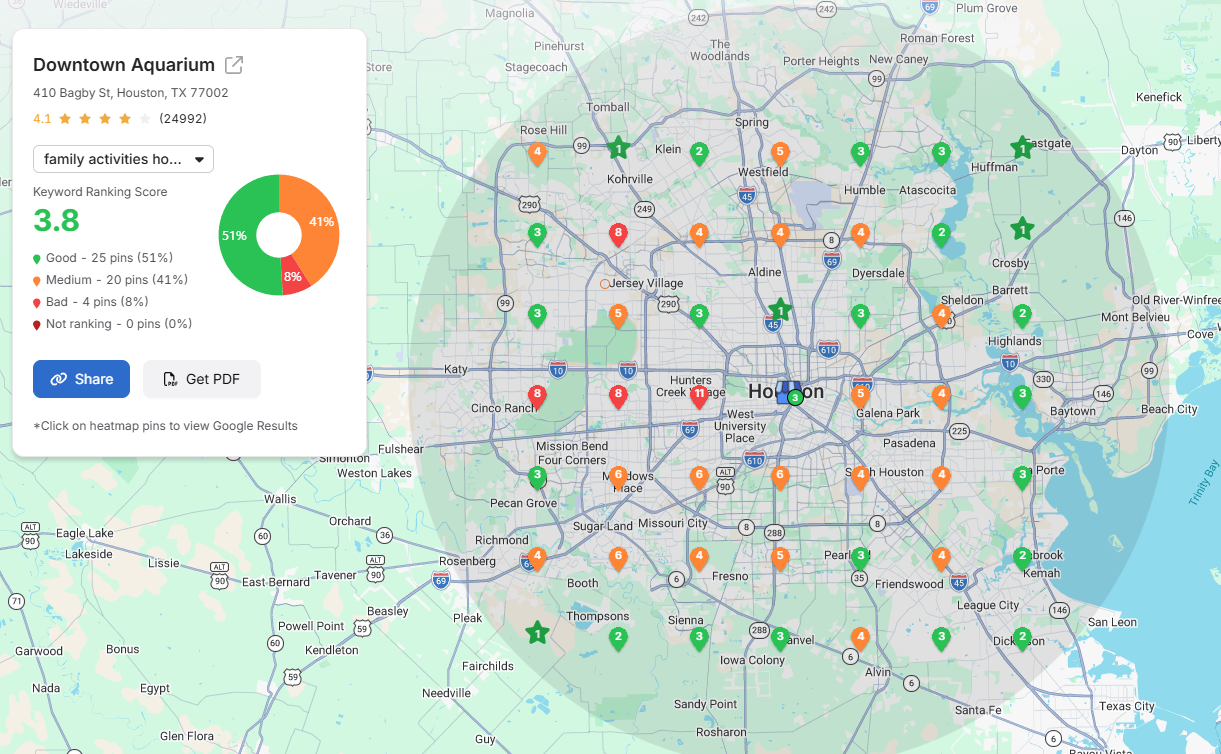
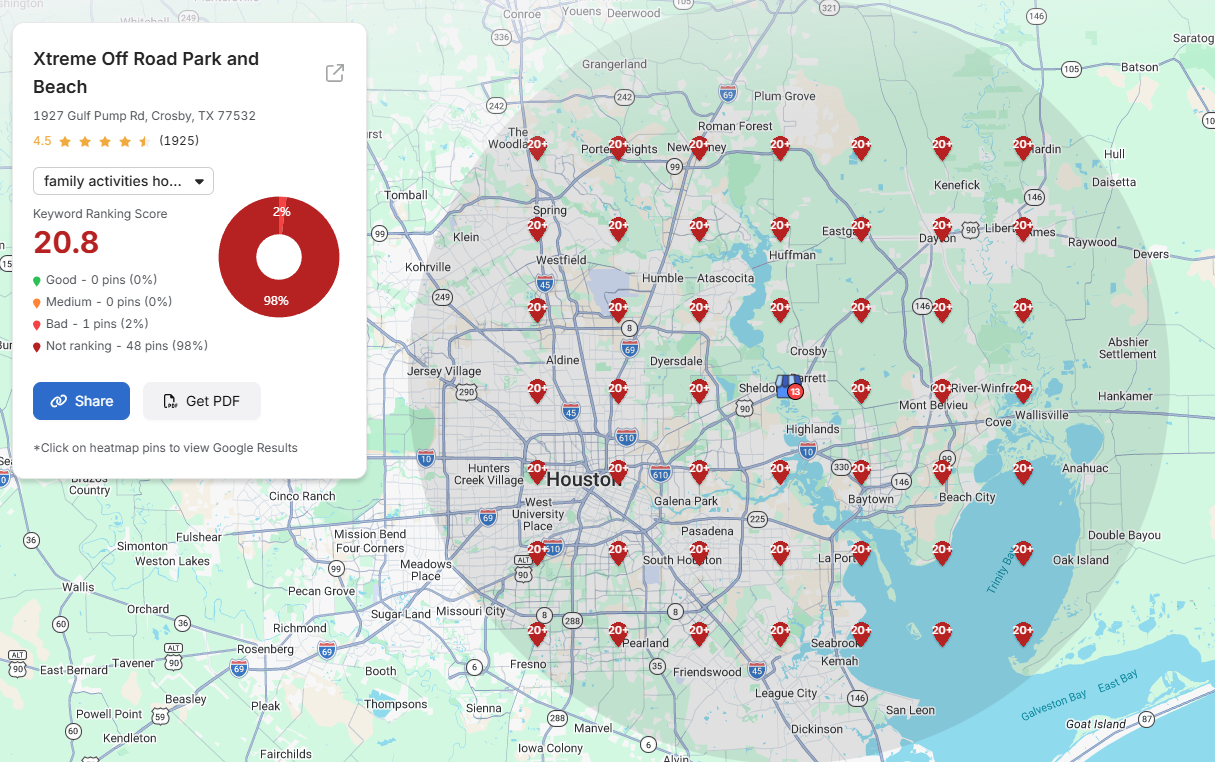
The Downtown Aquarium ranks #1 for "family activities Houston." Think about what that means. An aquarium is the same experience every visit — most families go once or twice before the novelty runs out. An off-road park is genuinely different every single time: weather changes the terrain, different rigs show up every weekend, trails evolve with wear and park adjustments. A kid who sets foot in an off-road park at eight years old is a rider, a builder, and a shop customer by eighteen. The lifetime value of that first visit is not comparable to a ticket to the aquarium. And that park is completely invisible in the search the aquarium is winning.
The Experience Economy Is Maturing
Escape rooms went from novelty to entrenched digital infrastructure in under a decade. Axe throwing chains ran the same playbook. Indoor climbing, trampoline parks, entertainment centers — all of them hired SEO firms, built location-by-location page architecture, and got indexed for every broad leisure search before their competitors understood what was happening.
The businesses that moved early hold those map pack positions now at minimal cost. The ones that waited are paying significantly more to compete for the same real estate. The window to be the early mover in outdoor motorsport and adventure is still open. It is narrowing.
Your Industry Is on Its Own Growth Curve
Polaris, Can-Am, and BRP are actively building consumer rental programs designed to expand the sport beyond its existing enthusiast base. Track day programs are growing as consumer-entry products. Karting centers are evolving into full motorsport experience venues. The consumer entering this industry for the first time today did not come through a club or a forum — they searched.
The parks and tracks that build infrastructure now will compound that advantage as the growth curve plays out. The ones that wait will be trying to buy their way into rankings that early movers established and held through time and authority accumulation.
Open a private browser. Search "outdoor activities in [your state]" and then "things to do in [your nearest city]." Note the first three results on each. Note what entertainment categories hold those positions. Note whether your venue type appears in the first two pages of either search. That gap is the infrastructure problem. It is still closeable.
The MEP contractor in your city with 60 vans and a name every general contractor in the metro knows — he did not get there on word of mouth. He got there by investing in infrastructure before the return was obvious. Search Atlas heatmaps for "HVAC company near me" in any major metro show what happened next: one player built first, the territory closed, and word of mouth kept smaller operators alive while the growth from new-to-category customers went entirely to the infrastructure owner. Parks and tracks are at the same inflection point.
Race Track Marketing and Website Infrastructure for Motorsport Venues
Most parks and tracks are operating on digital infrastructure that was never built for their business model — a family member's template site, a drag-and-drop build from five years ago, a Facebook page treated as a homepage. The cost is structural, not just aesthetic.
A karting center with no online booking path loses every consumer who searches at 9pm on a Friday. A motocross track with no dedicated race-day page leaves every out-of-state competitor searching manually for class information, entry fees, and gate procedures. A catch-all OHV park with twelve distinct trail systems described in a single paragraph loses the search traffic that twelve dedicated trail pages would each capture independently.
Every page Osiris builds earns its place as a trust signal, a search capture asset, or a conversion tool. The architecture differs by venue type.
Every venue gets the complete build for its type — all three layers below, delivered at launch. There is no starter package and no page-count ladder. What changes from one venue type to the next is the architecture, not how much of it you receive.
Core — Home, trail overview, difficulty rating system, day pass pricing, SxS/bike rentals if applicable, events calendar, safety and waiver info, FAQ, gallery, contact.
Depth — Individual trail pages (one per named trail, difficulty-rated, terrain-described), individual vehicle class pages, camping and lodging, guided experience packages, membership.
Reach — Broad leisure search capture pages targeting outdoor adventure, family activities, and things-to-do searches in every city and region within your geographic draw area.
Core — Home, track overview, practice session schedule, race day schedule, classes and eligibility, fees and registration, safety requirements, FAQ, gallery, contact.
Depth — Individual class pages (50cc through Open), coaching and rider development, membership and season passes, track conditions calendar, bike rental if applicable.
Reach — Local SEO pages targeting surrounding metro areas and competitive rider search terms across the regional draw area.
Core — Home, circuit overview, track day program, HPDE levels (1–4), pricing and schedule, track safety, FAQ, gallery, contact.
Depth — Individual event-type pages (track days, autocross, club racing, drift, driving schools), track car rental and ride-along programs, corporate and group packages, coaching and instructor programs.
Reach — Session-type and car-platform-specific pages capturing high-intent driver searches; broad leisure capture architecture for the "things to do" consumer.
Core — Home, kart types and speed classes, pricing (single race, packages, leagues), booking flow, corporate and group events, birthday packages, safety briefing, FAQ, gallery, contact.
Depth — Individual event pages, racing league registration and schedule, membership, track records and leaderboard, gift passes.
Reach — Full broad leisure capture architecture. Karting centers have the largest potential footprint in the "things to do" and "family activities" search pool of any venue type on this list.
Core — Home, track overview, event schedule (test-and-tune, bracket, grudge, special events), timing systems, class structure and rules, tech inspection requirements, spectator information, FAQ, gallery, contact.
Depth — Individual event pages, track records by class, time slip archive, diesel event hosting page (NHRDA/ODSS eligible), track rental for private events.
Reach — Regional draw pages and spectator experience pages targeting the non-competitor audience — the grudge-night crowd that has never been to a drag strip.
Architectures for these venue types are scoped specifically to the venue's configuration, revenue streams, and geographic draw area during the intake process. Each site is built to your venue's actual offering — not a generic template adapted from another category.
Venues also hold a place in the broader network beyond their own site build — see the Osiris venue partner program.
Osiris builds and hosts the site. You don't own it — you operate your venue. That structure is what keeps every page performing and the infrastructure current. Osiris does not build on your existing site or on third-party platforms. Every engagement includes a new Osiris-built site.
Two Layers of Search.
Most Venues Win One
And Ignore the Other.
Niche-intent searches. Person knows the category. You probably show up here with a healthy GBP and a functional site. This is the smaller pond.
Broad leisure-intent searches. Person is undecided. Open to anything. This is the ocean. Every entertainment vertical with digital infrastructure is fishing here. You are probably not.
What Osiris Builds For Both Layers
The niche layer and the broad leisure layer require different infrastructure — but neither works without the other. Niche domination without broad capture means you only ever reach the already-converted. Broad capture without niche lock means you're competing against every entertainment venue in your market without the community authority that makes your venue worth clicking.
GBP Audit & Category Rebuild
The most underused lever in venue digital presence. An OHV park listed only as "Off-highway vehicle area" is invisible for "family activities" searches. A karting center listed only as "Go-kart track" is invisible for "corporate events near me." A drag strip not listed under "Amusement park" is absent from the "things to do" map pack entirely. Osiris audits your full category configuration, identifies the exact categories closing you out of searches you should appear in, and rebuilds from there. The audit takes hours. The ranking expansion compounds for years.
Citation Accuracy — 30+ Directories
Inconsistent name, address, and phone data across directory listings is a local ranking suppression factor that compounds silently. Most parks and tracks have never cleaned it. We clean it in week one and monitor it continuously. Every wrong listing is a trust signal eroded and a ranking point lost.
OTTO Technical SEO — Daily Monitoring
Runs on your site daily. Catches crawl errors, indexation issues, schema failures, and page-speed regressions before they suppress rankings. The broad-search content architecture is a long-term compounding asset — OTTO is the maintenance infrastructure that keeps it compounding instead of quietly leaking. Daniel approves every substantive recommendation before implementation.
Broad Leisure Search Architecture
A dedicated page and content architecture targeting "things to do," "outdoor activities," "adventure near me," and "weekend experiences" across every city and region within your geographic draw area. Not generic blog content. Purpose-built landing pages with the correct schema, keyword structure, and geographic signals to position your venue as the answer when the undecided consumer runs the search that escape rooms and trampoline parks are currently winning.
Search Atlas Heatmap Baseline
At the start of every engagement, we run a 7×7 grid heatmap at a 10-mile radius centered on your venue for every primary niche-intent search term. That baseline shows your exact ranking position across your draw area before we start. Every 90 days, the same grid runs again. You watch your position move in real terms — not analytics reports, a visual grid showing where you rank by zip code.
Competitive Monitoring
Tracks where entertainment businesses and competing venues are ranking for broad leisure searches in your specific draw geography. When a competitor establishes a position for a search your venue should own, it surfaces before the position hardens into something expensive to displace.
One Page on This Domain Is Worth More Than Any Ad You've Ever Run
When your park or track joins the Osiris network, you get a dedicated profile on osirisautoguild.com — the Osiris-owned specialty automotive directory. One vetted venue per type per region. That is the consumer-facing function. The infrastructure function is what most venues never think about until they see it working.
The DFW Guild page is live and active. My Detail Guys — a founding network node, 17 years in business, 510+ Google reviews — has a dedicated external profile on osirisautoguild.com documenting every infrastructure change Osiris made and every result those changes produced. That profile is written by Osiris, from an external perspective, and links back to the shop. That is what Guild membership looks like at full execution.
The Guild is the consumer-facing face of the network. The network node program is how adjacent service shops plug into it, and how we manage every client's infrastructure is what keeps the whole system performing.
The Booking, Waiver, and
Follow-Up Infrastructure
Most Venues Aren't Running.
Parks and tracks across every type on this list share the same operational pattern: built by people who love the sport, running back-office operations that reflect it. The sport runs well. The revenue infrastructure around it runs the way it always has.
Abandoned Booking Recovery
Someone starts a day pass reservation, a track day registration, or a rental booking — gets interrupted, closes the tab. Without automation, that booking is gone. A reminder fires within 30 minutes with a direct link back to the open reservation. A second fires at 24 hours. Recovered revenue that required no additional marketing spend to generate.
Pre-Arrival Automation
Digital waiver delivered the moment a booking is confirmed — not emailed the morning of, not handed over on a clipboard at the gate. Venue directions, what to wear, what to bring, what to expect, safety briefing preview — all automated, timed to land 24 hours before arrival. For motocross tracks and road courses where equipment requirements are non-negotiable, this eliminates the gate rejection conversation.
Post-Visit Review Request
Fires automatically 24–48 hours after the visit, while the experience is still the most recent thing that happened to them. More reviews. Better average. Better GBP ranking position. Consistent review velocity is a direct local search ranking input — a venue with 20 new reviews this month outranks a venue with the same star average and reviews from 18 months ago.
Group & Corporate Inquiry Pipeline
Corporate events, team-building days, school groups, birthday packages, private track rentals — high-value inquiries that die when the follow-up arrives three days late. The first response fires within minutes of form submission, around the clock. A multi-touch sequence moves the inquiry from interest to booked without manual chase. For karting centers and race tracks, corporate event revenue can represent 20–30% of gross.
Membership & Pass Renewal Sequences
Annual pass holders get a renewal sequence starting 60 days before expiration. Monthly members get reactivation offers when subscriptions lapse. Day pass first-timers get a membership upgrade path 48 hours after their visit — when the experience is freshest and the motivation to return is at its highest. Each sequence runs on contact-record triggers. No manual intervention required.
Seasonal Re-Engagement
Your past visitor database is an owned audience. Before peak season. Before major event weekends. Before school breaks, holidays, and end-of-season closings. Automated campaigns reach past visitors with relevant content, segmented by visit history, membership status, and activity type. The drag racer gets the test-and-tune announcement. The first-timer SxS rider gets the guided trail weekend. The corporate contact gets the next private session calendar.
First-Timer Capture Pipeline
The person who has never been near your category sends an inquiry — "do you have anything for beginners?" "can I bring my kids?" "what do I need to know before I come?" — and the response arrives two days later. They booked something else. First-timer inquiries receive an immediate automated response with exactly what they need, followed by a sequence that walks them from question to booking. This buyer — found through a broad leisure search, category-new — has the highest long-term value in your entire customer base. Converting them once is the beginning. Losing them at the inquiry stage is the entire infrastructure problem in a single interaction.
Big Networks Fail When They Try to Be Everywhere at Once. We're Not Doing That.
Every company that has tried to build something like this has made the same mistake: spread to as many cities as they can reach, sign one or two venues per city, and discover that a half-built network produces nothing for anybody. Referrals require volume. Volume requires a complete network behind it. A directory spread thin across twenty cities is just a list of venues who paid for a promise.
Osiris doesn't spread thin. One metro gets built to completion before the next one starts — every vertical, every niche, every node, until the network in that city is full. A network half-built in twenty cities is worth less to everyone in it than a network finished in one.
What we don't do is decide in advance which city that is.
Nobody can know which market moves first, and publishing a regional roadmap would just be a guess wearing a plan's clothes. So outreach runs everywhere at once. The moment an anchor signs in a metro, that city becomes the focus — outreach elsewhere pauses, and we fill that market out completely before moving on.
Which means the answer to "when do you get to my city" isn't a date on a roadmap. It's: when a shop there signs. The first shop to move decides where the network builds next — and gets the whole market built around them.
This is the same territory and anchor model laid out in how Osiris works and the full vision behind the build — and the position it describes is the one explained in who the anchor is for.
- Building one metro to completion at a time
- Running outreach in every market at once until an anchor lands
- Letting the market choose the sequence
- Filling every vertical and node in a city before moving to the next
- Publishing a regional roadmap we can't honor
- Scattering clients across twenty cities we can't service properly
- Making you wait on a region you don't happen to be in
- Guessing which market is hungriest and betting the company on it
The proof is already live. Two founding network nodes — My Detail Guys and My Upholstery Guys, Dallas–Fort Worth, inside the Osiris network since 2025 — produced 48% gross revenue growth, doubled full-time headcount, and 73 new Google reviews in 8 months. That happened before the first anchor vertical ever signed in DFW. Infrastructure alone did that. The anchor network and referral layer activate on top of that foundation.
That infrastructure was built by an operator who came up in the specialty trades, not in marketing — the Osiris story.
Common Questions
One Venue Per
Type Per State.
Not Negotiable.
One off-road park. One motocross track. One road course. One karting center. One drag strip. One per category, one per state.
The infrastructure we build for each venue creates a statewide search footprint for that venue type — page architecture targeting the broad leisure searches and the niche intent searches across every city and draw region in the state. That architecture has full value only when it is built for one venue per category, not fragmented across competing properties in the same state.
One per type per state means every Osiris client operates with the full infrastructure advantage in their category for the full duration of their partnership. When a state slot fills, it fills.