Diesel Performance Shop Marketing in Oklahoma City. The Repair Shop Is Ranking. That Gap Is Yours.
"Diesel performance shop Oklahoma City" looks contested. It isn't. Every result ranking for that keyword is a diesel repair operation that added "performance" somewhere in its description. None of them built for the performance buyer. The first shop that does won't compete for that position — it will own it. Oklahoma runs on work diesels, and the build culture here is as real as anywhere in the country.
Oklahoma City Has Diesel Shops. It Doesn't Have a Diesel Performance Shop Online.
The diesel performance buyer has done more research than most shops give him credit for. He knows the difference between a canned tune and a custom EFI Live file. He knows what the stock CP3 can handle and where it fails. He knows what breaks first when you push a stock drivetrain past 600hp. He's been in forums, watched build videos, and priced out the sequence before he ever contacts a shop.
What he's looking for when he searches is the shop that knows what he knows — and can prove it before he calls.
Right now in Oklahoma City, that shop doesn't exist online. The results ranking for "diesel performance shop Oklahoma City" are diesel repair operations — more reviews, more GBP history, more domain authority, earned on service work, not on tuning, fuel, and compound-turbo builds. This is oil-and-gas and Plains agriculture country: trucks that tow and haul for a living, and one of the most authentic sled-pull and work-diesel cultures anywhere. OKC also bridges the Texas and Southwest markets. The performance buyers are here in numbers — the shop they're searching for isn't online yet.
That gap is the whole business case. The performance buyer is out there. He just can't find the right shop. And the right shop — yours — isn't showing up for him.
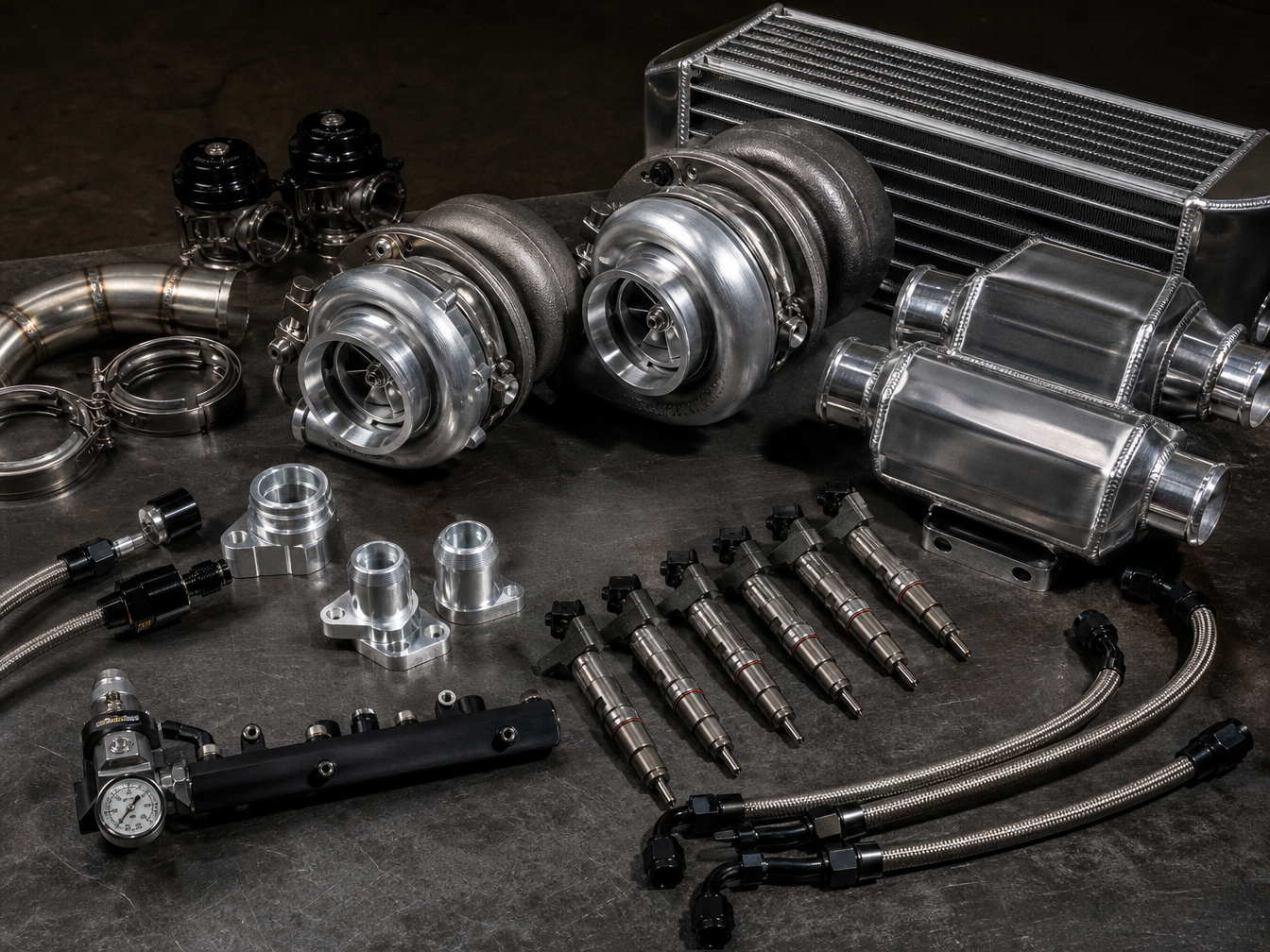
Diesel Performance SEO: The Position Is Less Contested Than the Keyword Suggests
Open a new browser tab. Search "diesel performance shop Houston."
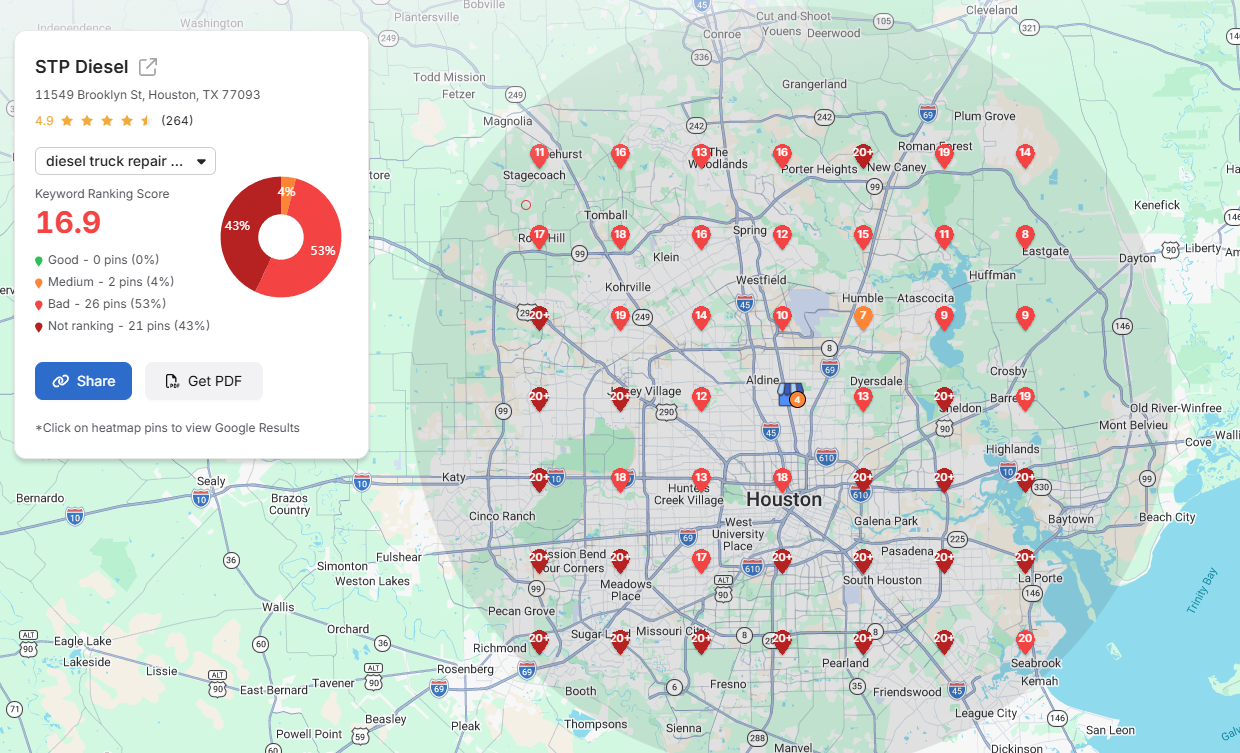
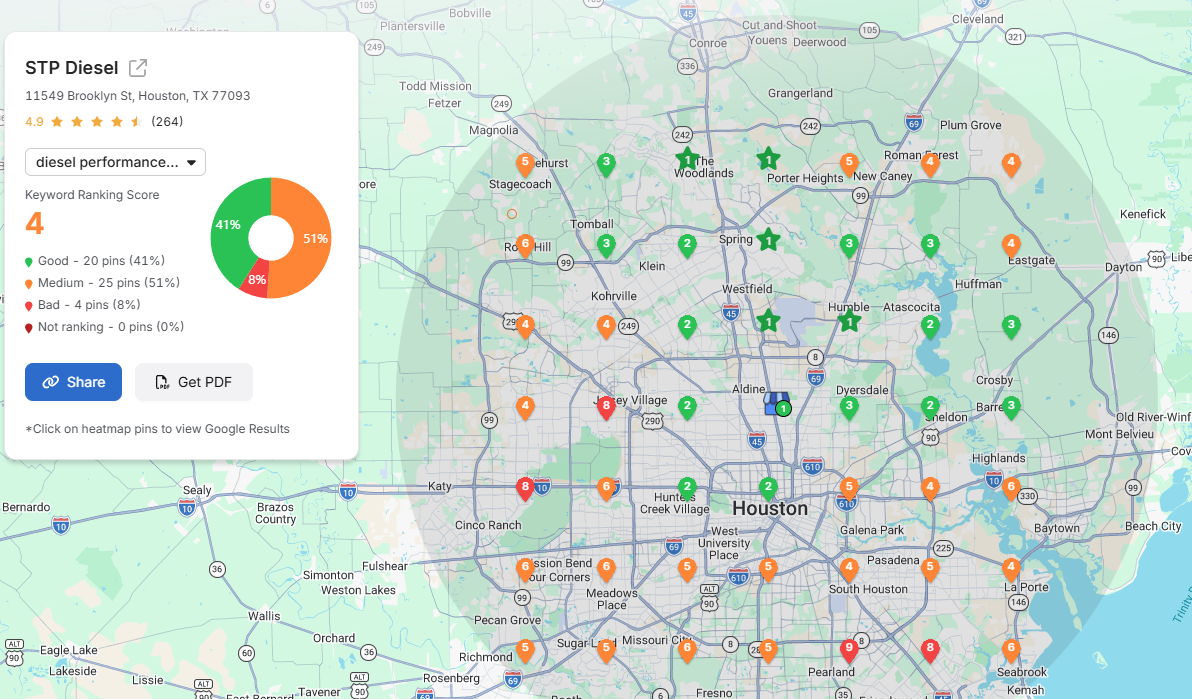
The #1 result is STP Diesel. The #2 result is PSP Diesel. Both are legitimate operations — established, well-reviewed, with real heatmap presence across the metro. These aren't fly-by-night listings. They've put in the work on the repair side and it shows.
Now click through and look at the sites. Find the Cummins-specific build page. The Power Stroke performance page. The Duramax compound turbo page. The EFI Live tuning content. The dyno gallery with before-and-after horsepower and torque numbers. The competition prep page. The build showcase.
You'll be looking for a while. Across the top two results in the largest diesel truck market in the country, 95% of the service content is repair and replace — not performance. These shops rank for "diesel performance shop Houston" because they've built diesel authority over years, not because they've built performance infrastructure. The keyword doesn't know the difference. The performance buyer does.
Now look at the top of the page. Google isn't even surfacing a map pack for this keyword. No 3-box. No proximity advantage. No GBP shortcut. "Diesel performance shop Houston" is classified as a content authority query — meaning the only thing that determines who ranks is what's on the website. And sitting above the organic results is an AI Overview summarizing the top shops and calling them diesel performance options. Every shop it cites — PSP, STP, Longhorn — is described in repair terms because that's all their content supports. That AI slot is a citation position. It goes to whoever builds the content that earns it.
The digital marketing position for diesel performance in Houston isn't contested. It's unclaimed. There's no map pack to fight for, no incumbent with a performance-built site, and an AI Overview actively looking for something worth citing. That is the opening. If it exists in the largest diesel market in the country, it exists in Oklahoma City.
You got into diesel to build. You already know what your calendar looks like — oil changes, DEF system repairs, warranty work that keeps the lights on. You take repair jobs because you have to, not because you want to. The performance buyers who should be filling that calendar with custom tunes, fuel system builds, and compound setups aren't finding you. They're finding the repair shop with more reviews from 2019.
When you own "diesel performance shop Oklahoma City" organically, the repair work becomes optional. You close the builds you got into this for. You take repair when you choose to — not because it's all that's coming in.
Repair is your foundation. You're not losing the performance market — you never went after it. But here's how it's actually playing out for the buyer who wants what you're capable of building.
He searches "diesel performance shop Oklahoma City." Finds the same two or three diesel repair shops every search returns. Clicks through, does his homework, figures out they're repair shops that also do some performance. Goes back to the results. Scrolls past the forums. Scrolls past the aggregators. Eventually finds the small shop that actually IS a performance operation — three bays, one guy who knows exactly what he's doing — and then lands on a GoDaddy website the owner built on a Sunday afternoon. No dyno sheets. No build showcase. No evidence that they've done the job he needs done.
He's looking at spending $10,000 to $30,000 on a truck worth twice that. He is not handing those keys to a shop that won't spend $3,000 on a website. If you're not serious about your own presentation, why would he believe you're serious about his build?
So he goes back to the top of the list. He calls the repair shop with the reputation. Not because they won. Because at least they have a reputation to lose.
You're closing that buyer — but not because you earned it. He came in frustrated, already settling. That buyer haggles. That buyer second-guesses. That buyer doesn't refer the next guy.
The digital marketing infrastructure changes what you're winning. The buyer who finds you through a platform page, a build showcase with real dyno numbers, a compound turbo page written by someone who knows what a compound setup actually involves — that buyer isn't settling. He chose you. Those two buyers are not the same customer. They don't spend the same, they don't refer the same, and they don't come back the same.
You don't have to give up a single repair bay. You just have to show up online the way your shop shows up in person.
Diesel Performance Shop Marketing Built for Cummins, Power Stroke, and Duramax Builders
The diesel performance buyer researches before he calls. He's reading platform-specific pages, looking at dyno numbers, checking whether a shop has built the configuration he's planning. Drop Forged Diesel is Osiris's diesel performance demo site — gunmetal build, forge-red accents, platform-fluent copy written for the buyer who already knows the difference between a CP3 conversion and a lift pump upgrade.
There is one build, and every shop gets all of it.
The Diesel Performance site is already finished. Every platform you work on, every service you sell, every diagnostic query your buyers type, every local page your market needs — built to full depth before we ever called you.
So there are no tiers and no page-count ladder. Handing you a fraction of an asset that already exists, then billing you monthly to release the rest of it two pages at a time, isn't a service. It's a way to make the work last. Those pages cost nothing to hand over, and withholding them would only handicap you in the market we're being paid to help you take.
Your competitor is on an eight-page site. You'd be on sixty. Those aren't two points on the same curve — they're two curves, and they separate fast. Most shops won't notice for a year, because nobody in these markets is watching search closely enough to catch it.
Not every diesel shop is the right fit for this build. If performance is a line item on a repair menu, this infrastructure won't move the needle. If the performance side of your business is where you're going — or where it was always supposed to go — this is the infrastructure that makes that happen.

SEE ONE LIVE
Drop Forged Diesel — a diesel performance site we built
A fictional Houston shop running the exact infrastructure described on this page. No Google Business Profile, no reviews, no real address — and it still ranks and books consultations. This is the starting point for your site.
Visit Drop Forged Diesel →Diesel Performance SEO in Oklahoma City for the High-Intent Buyer Who Already Decided
The Oklahoma City diesel performance buyer who searches "Cummins compound turbo build Oklahoma City" isn't browsing. He knows what he wants built. He's looking for the shop that can prove they've done it. The search architecture Osiris builds is designed for that moment — not the moment before it.
Buyer Queries We Rank For
One anchor client per diesel performance vertical per market. Once it’s taken, it’s taken — the website, the SEO, and the automation engine belong to that shop alone.
Technical SEO, Built In
Technical SEO is built in, not patched on — schema, speed, clean structure, and indexing handled in the build. Rankings and competitor movement are tracked every month, so problems get caught before they cost you calls.
Google Business Profile
GBP is treated as a second search surface, not an afterthought. Platform-specific categories, diesel-relevant attributes, build photos, review velocity. The buyer who searches on Maps finds the same shop that ranks on Search.
Competitive Monitoring
We track what the repair shops ranking above you are doing — when they add content, when their rankings shift, when a new shop enters the market. You hold an active position on the field, not a website that ranks until something changes.
Territory Lock
The anchor slot in your market is yours exclusively for as long as you're on the platform. No competitor can buy in. No second diesel performance anchor in your territory. The lock is structural — it's in the MSA, not just in the pitch.
The complete breakdown of what that exclusivity position includes — territory lock, full-stack infrastructure, quarterly war room sessions, and the full niche architecture for this vertical — is at how Osiris works.
One Page on This Domain Is Worth More Than Any Ad You've Ever Run
When you sign with Osiris, you get a dedicated profile on the Osiris Auto Guild — the Osiris-owned specialty automotive directory. One vetted shop per specialty per city. That is the consumer-facing function. The infrastructure function is what most shops never think about until they see it working.
The DFW Guild page is live and active. My Detail Guys — a client, 17 years in business, 510+ Google reviews — has a dedicated external profile on the Osiris Auto Guild documenting every infrastructure change Osiris made and every result those changes produced. That profile is written by Osiris, from an external perspective, and links back to the shop. That is what Guild membership looks like at full execution.
Powerstroke, Cummins, and Duramax Shop Marketing With Pipeline Infrastructure to Match
The diesel performance buyer reaches out to more than one shop. He buys from the first one that responds — not the best one, not the one with the most reviews. The first one. A diesel performance build is a $4,000 to $25,000 decision the buyer has been researching for weeks. He is ready. If your shop doesn't respond in under five minutes, he's already on the phone with the shop that did.
A shop responding in under 5 minutes is 21× more likely to close the lead than one that waits 30. Every web lead submitted through your Osiris site receives an automated text response in under 2 minutes — whether you're on the dyno at 4pm or under a truck at 8am. The consultation gets booked. The build gets closed.
The diesel performance buyer reads more reviews than most — he's vetting technical credibility, not just checking the star rating. A shop with strong performance-specific reviews earns the call before the shop with twice as many reviews for oil changes. The Osiris CRM triggers a review request after every completed job, automatically. Review count grows without adding a single task to your workflow.
The buyer who submitted a form and didn't hear back isn't gone. He's still in market — either waiting or about to give the job to someone else. The Osiris pipeline identifies every stalled lead and re-engages it automatically — a follow-up text at 24 hours, a second at 72. Most shops let these leads expire. Yours doesn't.
Common Questions.
One Slot in Oklahoma City.
Check If It's Still Open.
One diesel performance shop per market. Once Oklahoma City’s is taken, it’s taken — the website, the SEO, and the automation engine behind them belong to that shop alone. We don’t build any of it for the shop down the road.